

A visit of 5th and 6th graders from Escondido to the MOD labs and the Scripps campus this past Saturday marked the end of an unusual class setting: Learning about physical oceanography through dance. Over several sessions in the past few weeks, the students heard about ocean physics and ocean observations from physical oceanographers Larry Pratt and Gunnar Voet. In between the lessons, the students, together with their dance teacher Roxanne Rojas de Blanco, came up with dance moves to transform what they had just learned into a choreography. With a lot of creative energy the students danced ships in stormy seas and subsurface oceanographic moorings knocked over by strong currents.
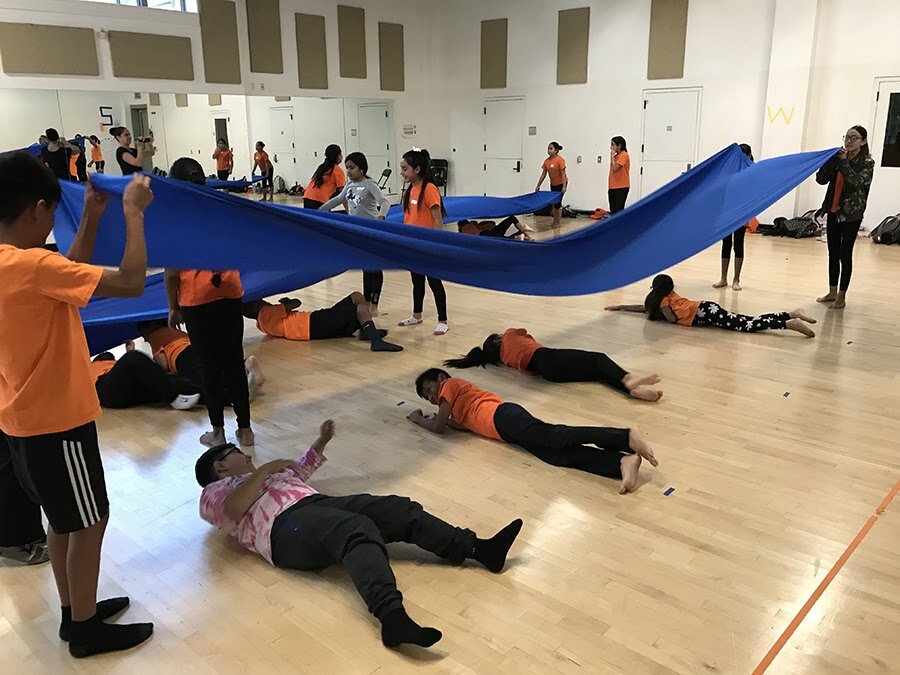
Dancing wave orbits.

Larry Pratt answering student questions.
During their Scripps visit, the students carried out tank experiments to learn about density in the ocean. To put into action what they had learned about moored observations, they tested an acoustic release. A walk across the campus ended on the Scripps pier with seal, leopard shark and sting ray sightings.

Visiting the test pool at Scripps.

Students observing dense water plumes in tank experiments on ocean density.

Sending a ping through the acoustic deckset…

…and making sure the acoustic release responds.
Many thanks to Roxanne at A Step Beyond and our colleague Larry Pratt from WHOI for organizing this workshop, and to the National Science Foundation for financial support through our Samoan Passage research project!
